
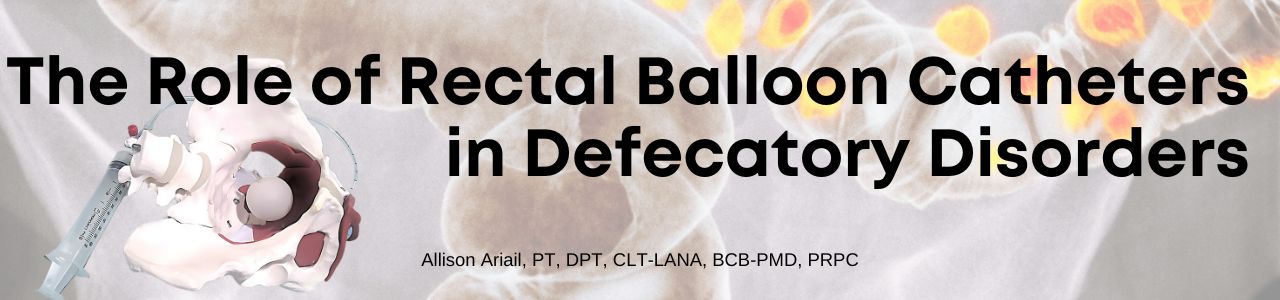

When it comes to treating defecatory disorders, particularly fecal incontinence and chronic constipation, innovation can be a game changer. Enter rectal balloon catheters—a tool that, despite initial discomforting imagery, offers significant benefits for patients struggling with these conditions.
At first glance, the thought of a balloon being inserted into the anus may provoke apprehension. However, it's essential to understand that the size of these balloons is smaller than that of an average bowel movement, making their use far more manageable than one might expect. The primary role of these catheters is to provide sensory retraining in the anal canal, an aspect of treatment that is otherwise challenging to achieve.
Numerous studies have highlighted the effectiveness of rectal balloon catheters. For instance, research by Bright et al. in 2005 showed that when patients squeeze to retain a balloon, it effectively mimics the physiology of defecation. This process aids in improving maximal anal squeeze pressures, a vital aspect of bowel control.
As the study states, “External anal sphincter contraction is difficult for some patients to perform on request. With traction on a balloon catheter, anal squeeze pressures improved in most patients. This indicates that many patients perform maximal anal squeeze pressures better once that muscle group has been tested in a more normal physiological function.”
This revelation underscores the potential of balloon catheters in not only retraining muscle function but also in enhancing patient confidence during bowel movements.
The key to success with rectal balloon catheters lies in careful patient selection. Not every patient will benefit from this approach, but for those who do, the results can be transformative. Many have reported significant improvements in their ability to manage symptoms and regain control over their bowel functions.
Are you still feeling apprehensive about integrating balloon catheters into your practice?
It’s understandable. Take a course to build your confidence and learn how to use this remarkable clinical tool. In Anorectal Balloons: Introduction and Practical Applications you will learn the research that supports the use of balloon catheters, as well as evaluation and treatment techniques using anorectal balloons. You will participate in a lab to ensure proper handling. Anorectal Balloons: Introduction and Practical Applications is an online course lasting 5.5 hours. Join me on December 14 to learn more about anorectal balloon catheters so that you can add this tool to your clinical repertoire.
Rectal balloon catheters may initially seem daunting, but they represent an essential advancement in the treatment of defecatory disorders. With the right training and patient selection, you can add this remarkable clinical tool to your repertoire and make a profound difference in your patients' lives.
Resources:
Bright T, Kapoor R, Voyvodich F, Schloithe A, Wattchow D. The use of a balloon catheter to improve evaluation in anorectal manometry. Colorectal Dis. 2005 Jan;7(1):4-7. doi: 10.1111/j.1463-1318.2004.00698.x. PMID: 15606577.
AUTHOR BIO:
Allison Ariail, PT, DPT, CLT-LANA, BCB-PMD, PRPC
 Allison Ariail has been a physical therapist since 1999. She graduated with a BS in physical therapy from the University of Florida and earned a Doctor of Physical Therapy from Boston University in 2007. Also in 2007, Dr. Ariail qualified as a Certified Lymphatic Therapist. She became board-certified by the Lymphology Association of North America in 2011 and board-certified in Biofeedback Pelvic Muscle Dysfunction by the Biofeedback Certification International Alliance in 2012. In 2014, Allison earned her board certification as a Pelvic Rehabilitation Practitioner. Allison specializes in the treatment of the pelvic ring and back using manual therapy and ultrasound imaging for instruction in a stabilization program. She also specializes in women’s and men’s health including conditions of chronic pelvic pain, bowel and bladder disorders, and coccyx pain. Lastly, Allison has a passion for helping oncology patients, particularly gynecological, urological, and head and neck cancer patients.
In 2009, Allison collaborated with the Primal Pictures team for the release of the Pelvic Floor Disorders program. Allison's publications include: “The Use of Transabdominal Ultrasound Imaging in Retraining the Pelvic-Floor Muscles of a Woman Postpartum.” Physical Therapy. Vol. 88, No. 10, October 2008, pp 1208-1217. (PMID: 18772276), “Beyond the Abstract” for Urotoday.com in October 2008, “Posters to Go” from APTA combined section meeting poster presentation in February 2009 and 2013. In 2016, Allison co-authored a chapter in “Healing in Urology: Clinical Guidebook to Herbal and Alternative Therapies.”
Allison works in the Denver metro area in her practice, Inspire Physical Therapy and Wellness, where she works in a more holistic setting than traditional therapy clinics. In addition to instructing Herman & Wallace on pelvic floor-related topics, Allison lectures nationally on lymphedema, cancer-related changes to the pelvic floor, and the sacroiliac joint. Allison serves as a consultant to medical companies, and physicians.
All Upcoming Continuing Education Courses

Menopause Transitions and Pelvic Rehab - Remote Course - January 17 - 18 2026
Jan 17 2026 - Jan 18 2026

Pelvic Function Level 1 - Satellite - Bethpage NY - January 24 - 25 2026- SOLD OUT
Jan 24 2026 - Jan 25 2026

Pelvic Function Level 2B - Satellite - Port St. Lucie FL - January 24 - 25 2026
Jan 24 2026 - Jan 25 2026
Pelvic Function Level 1 - Satellite - Woodbury NY - January 24 - 25 2026 - SOLD OUT
Jan 24 2026 - Jan 25 2026

Pelvic Function Level 2B - Satellite - Indianapolis IN - January 24 - 25 2026 - SOLD OUT
Jan 24 2026 - Jan 25 2026


Pelvic Function Level 2B - Satellite - St. Augustine FL - January 24 - 25 2026
Jan 24 2026 - Jan 25 2026


Pelvic Function Level 1 - Satellite - Bradenton FL - January 24 - 25 2026 - SOLD OUT
Jan 24 2026 - Jan 25 2026

Pelvic Function Level 1 - Satellite - New York NY - January 24 - 25 2026 - SOLD OUT
Jan 24 2026 - Jan 25 2026

Pelvic Function Level 1 - Satellite - Los Angeles CA - January 24 - 25 2026 - SOLD OUT
Jan 24 2026 - Jan 25 2026



Pelvic Function Level 1 - In-Person - Columbus OH - January 31 - February 1 2026
Jan 31 2026 - Feb 1 2026

Pelvic Function Level 2C - Satellite - Boston MA - January 31 - February 1 2026
Jan 31 2026 - Feb 1 2026

Pelvic Function Level 2C - Satellite - Omaha NE - January 31 - February 1 2026
Jan 31 2026 - Feb 1 2026


Pelvic Function Level 1 - Satellite - Fairfax VA - February 7 - 8 2026 - SOLD OUT
Feb 7 2026 - Feb 8 2026

Pelvic Function Level 1 - Satellite - Queens NY - February 7 - 8 2026 - SOLD OUT
Feb 7 2026 - Feb 8 2026



Pelvic Function Level 1 - Satellite - Greenwich Village NY - February 7 - 8 2026 - SOLD OUT
Feb 7 2026 - Feb 8 2026


Pelvic Function Level 2B - Satellite - Seattle WA - February 14 - 15 2026 - SOLD OUT
Feb 14 2026 - Feb 15 2026

Pelvic Function Level 2B - Satellite - Galloway NJ - February 14 - 15 2026
Feb 14 2026 - Feb 15 2026
Pelvic Function Level 2B - Satellite - Owensboro KY - February 14 - 15 2026
Feb 14 2026 - Feb 15 2026

Mobilization of Visceral Fascia: Urinary - Satellite Lab Course - Torrance CA - February 20 - 22 2026
Feb 20 2026 - Feb 22 2026

Mobilization of Visceral Fascia: The Urinary System Satellite Lab Course - Self-Hosted - February 20 - 22 2026
Feb 20 2026 - Feb 22 2026

Mobilization of Visceral Fascia: Urinary - Satellite Lab Course - Lake Stevens WA - February 20 - 22 2026
Feb 20 2026 - Feb 22 2026

Mobilization of Visceral Fascia: Urinary - Satellite Lab Course - Medford OR - February 20 - 22 2026
Feb 20 2026 - Feb 22 2026
Pelvic Function Level 1 - Satellite - Nashville TN - February 21 - 22 2026
Feb 21 2026 - Feb 22 2026
Pain Science for the Chronic Pelvic Pain Population - Remote Course - February 21 - 22 2026
Feb 21 2026 - Feb 22 2026