


Stacey Roberts PT, RN, MSN is an expert on shockwave therapy. Since 2020, Stacey Roberts has been analyzing shockwave research extensively to develop clear and concise therapeutic applications in the rehabilitation setting for pelvic health, sexual health, and muscular-skeletal patients. She is finding extraordinary results with her patients using this modality in her cash-based practice. Stacey joined the Herman & Wallace faculty in 2021 with her course Shockwave Treatment: Therapeutic Interventions in Pelvic Health & Demystifying the Research.
Below Stacey provides some FAQs and answers to the most commonly asked questions about shockwave therapy.
What is a Shockwave?
A shockwave is an interesting phenomenon and can be both natural and manmade. The Encyclopedia Britannica defines a shockwave as "a strong pressure wave in an elastic medium such as air, water, or a solid substance, produced by supersonic aircraft, explosions, lightning, or other phenomena that create significant changes in pressure.”
What is Shockwave Therapy?
Shockwaves used in therapeutic settings are produced by modalities that create supersonic waves. These waves penetrate the human tissue and can travel to areas of the body, producing a biological effect. The first therapeutic use of shockwave therapy was lithotripsy. This procedure was first used in the 1970s and utilizes high-energy high-intensity shockwaves to break apart kidney stones without surgical intervention.
Clinics now use low-intensity focused and unfocused shockwaves to exhibit a form of energy within the tissues. The shockwaves are made up of 3 phases: a mechanical phase, a chemical phase, and a biological phase. A true shockwave device impacts the tissue and can increase blood flow, activate connective tissue, modulate the inflammatory response, and contribute to pain relief.
Is there just one type of Shockwave device?
No, there are 3 types of true shockwave devices.
- Electrohydraulic (deepest biological effect) The only type of shockwave that has two different applicators (focused only and broad-focused)
- Electromagnetic (minimal to moderate biological effect) Applicator: Focused only
- Piezoelectric (minimal biological effect) Applicator: Focused only
Why is Shockwave therapy beneficial?
When a true shockwave device is used, patients often note faster improvement than with manual therapy alone or with other standard modalities such as ultrasound, laser, and radial wave therapies.
In my experience, the depth of penetration also allows my skills as a manual therapist to be used more effectively. By using shockwave therapy, I can now treat an area in 5 minutes that previously would have taken 10-15 minutes. It also tends to be much more comfortable for the patient.
Are radial, pneumatic, or EPAT true shockwave devices?
No, they have been lumped under the shockwave umbrella but do not produce the force or effect of a true shockwave. These devices have therapeutic value for superficial musculoskeletal injuries, including plantar fasciitis and lateral epicondylitis. However, the energy produced by the mechanical pounding of the tissue from a radial wave device does not produce a shockwave.
The energy produced by radial pneumatic devices disseminates just below the surface of the skin. An electrohydraulic shockwave device can produce a biological effect up to four to six inches from its point of contact, making this particular type of shockwave device especially useful for pelvic floor therapy.
Electromagnetic shockwave devices can penetrate approximately two inches depending on the device. And the piezoelectric device produces most of its effects within an inch or so below the surface.
I see ESWT in the research a lot. Is that shockwave therapy?
ESWT stands for Extracorporeal Shockwave Therapy. This is a common abbreviation used in the literature that originally was meant to label shockwave devices. However, other non-shockwave devices, such as radial pressure wave devices, also use ESWT to describe them in research studies.
In the true sense of the word, and shockwave definition based on the physics of what is produced by the applicators,, a radial device is not true shockwave. There is much confusion in the research that takes time to unravel, so I have dedicated a portion of the Shockwave course to tease out the differences. Many clinicians own a radial device and were told that it was a shockwave device. Unfortunately, according to the International Society for Medical Shockwave Treatment (ISMST) that is not completely accurate.
What can be treated with true Shockwave therapy related to Pelvic Rehab?
True shockwave therapy has been shown to be beneficial for the following issues:
- Erectile Dysfunction
- Peyronie’s Disease
- Chronic Prostatitis
- Chronic Pelvic Pain
- Incontinence
- Urgency
- Cystitis
- Vaginismus
- Vulvodynia
- Vestibulodynia
- Dyspareunia
- Persistent Genital Arousal Disorder (PGAD)
Other areas of upcoming research:
- Dysmenorrhea
- Endometriosis
- Testicular Pain and Dysfunction
- Premature ejaculation
- Urinary retention
- Fibroids
How is shockwave different from ultrasound?
A wave produced by ultrasound is a sinusoidal wave versus a shockwave that has a strong positive pressure followed by a longer negative pressure wave. See chart:
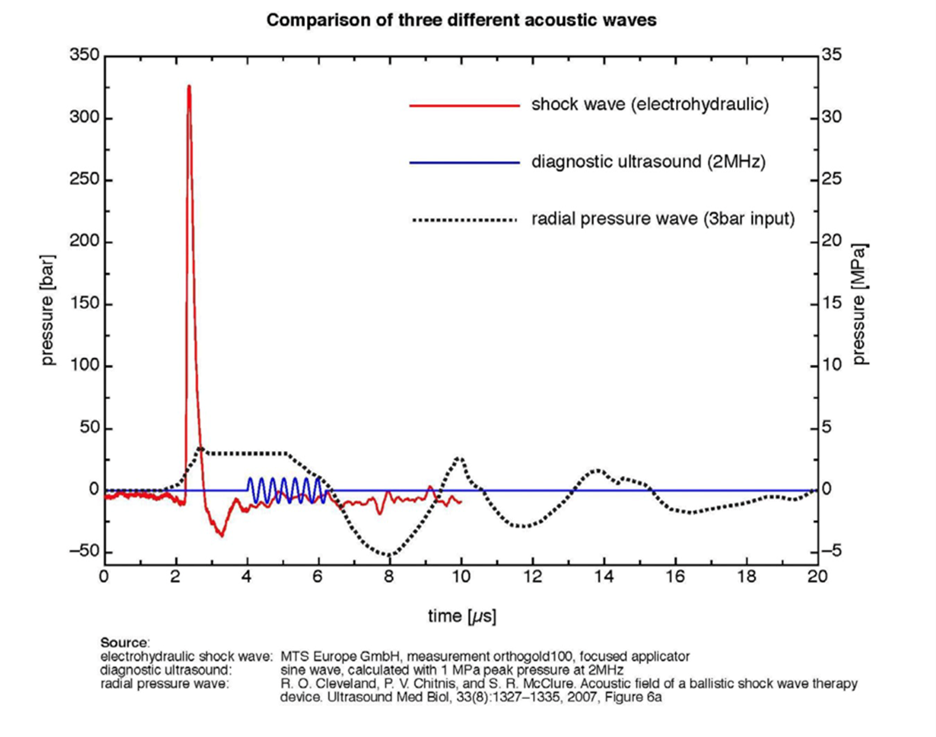
This results typically in shockwaves creating larger cavitation bubbles around the cellular structures and fewer treatments to reach patient goals. Continuous ultrasound produces its effect by heating the tissue, whereas a shockwave device does not cause any heating of the tissue to produce its therapeutic effect.
Is shockwave therapy covered by insurance?
Like other valuable modalities, insurance does not typically cover low-intensity shockwave therapy. However, in times of decreasing reimbursement, patients are increasingly turning to fee-for-service methods and paying out of pocket for treatments that result in positive outcomes in shorter periods of time.
Why should I take your course Shockwave Treatment: Therapeutic Interventions in Pelvic Health & Demystifying the Research?
You should take this course if you are interested in:
- Learning how one of the most effective non-invasive treatment modalities of our time related to pelvic and sexual health produces its results
- Understanding how this modality produces its results and how it is being utilized in clinics to improve treatment outcomes related to pelvic health
- How this modality can enhance results when combined with manual treatment techniques and other treatments such as dry needling, PRP, or stem cell therapy.
- How to save enormous amounts of time while reviewing the research efficiently without combing through data that may or may not be actual Shockwave research
- Being able to differentiate one machine from another to make an educated decision on which shockwave device may fit best into your clinic
- What questions to ask company sales reps who are selling devices to make sure you are talking about a true shockwave device
If you would like to learn more about incorporating shockwave therapy into your daily practice, then join H&W Shockwave Treatment: Therapeutic Interventions in Pelvic Health & Demystifying the Research on October 27, 2024.
AUTHOR BIO
Stacey Roberts, PT, RN, MSN

Stacey Roberts, PT, RN, MSN (she/her), has been a physical therapist specializing in outpatient orthopedics and sports medicine, since 1990. After completing a sports medicine fellowship and working at several hospitals and outpatient clinics, in 2000 Stacey had an opportunity to move overseas, where she became adept with complementary medicine approaches, becoming a master in herbalism in 2003. From 2004 to 2017, Ms. Roberts owned and operated a cash-based health and wellness clinic on the Gold Coast of Australia specializing in women’s health and hormones and couples' fertility, where she began seeing patients via Telehealth in 2006.
Combining her knowledge of functional medicine, conventional medicine, and complementary medicine, Stacey emphasizes lifestyle changes, and her treatment programs are based on cutting-edge evidence-based research. Currently, she is a co-principle investigator for an IRB-approved study related to shockwave and Dyspareunia.
She has written 3 hard-copy books and 7 ebooks on women’s health and couples' fertility. Her new book, The Pain-Free Formula: A Holistic Approach to Finally Getting Rid of Pain Without Surgery, Drugs, Or Injections, is coming out in 2025. Ms. Roberts has mentored over 100 medical professionals in her women’s health and couples fertility training program. After returning to the United States, Stacey was hired by a national physical therapy company, Aegis Therapies, from 2018 to 2020 to assist in the growth and development of their orthopedic outpatient practice in Wisconsin. She set records for the company related to bringing clinics to profitability faster than any of their other outpatient clinics in the country at that time.
From 2016- to 2020 Stacey was an associate clinical professor at the University of Wisconsin Milwaukee’s Physical Therapy doctoral program until opening New You Health and Wellness, a cash-based clinic, where she brings her knowledge of wellness, hormone health, fat loss, and musculoskeletal health to treating patients with issues related to musculoskeletal injuries, sexual health, and pelvic health. Since 2020 she has been analyzing Shockwave research extensively to develop clear and concise therapeutic applications and protocols for pelvic health, sexual health, and muscular-skeletal patients. She is finding extraordinary results with her patients using this modality in her cash-based practice.
Stacey completed her MBA in 2021, her RN license, and her master’s in nursing (MSN) in 2020. She will eventually complete a nurse practitioner certificate. Stacey has also appeared on World News Now in New York, was featured on Oprah, locally on TMJ4’s Morning Blend, and on several news shows and radio stations in the United States and Australia.

If you’ve spent any time on social media as a healthcare practitioner, you’ve probably encountered a flood of ads promoting shockwave therapy as a miracle solution for everything from orthopedic pain to urological and gynecological conditions. The marketing push for these devices has skyrocketed over the past five years, driven by claims of its ability to treat a wide range of diagnoses. Recent research, including a comprehensive review published in The Journal of Clinical Medicine, confirms that shockwave therapy is making significant waves in modern medicine. But with all the buzz surrounding this technology, the real question remains: is it truly a game changer for patients and clinics alike?
As a medical professional, my approach to any new treatment, procedure, or modality begins with skepticism. I believe it is my responsibility to ensure that the interventions I offer in my clinic are grounded in solid research, and proven efficacy. When I first encountered shockwave therapy in early 2020, I was highly skeptical. The companies I spoke with made sweeping claims, portraying shockwave therapy as a universal solution for virtually every condition. Despite their promises, I remained cautious. However, after hearing positive feedback from a few trusted colleagues and witnessing a session that yielded seemingly impressive results, I decided to delve deeper into the research.
I found that while there is a substantial amount of literature available, much of it is confusing and, it lacks clarity — especially in the area of pelvic health. The majority of the research outside of orthopedics focuses on conditions such as erectile dysfunction, with little attention given to men’s pelvic health concerns and even less given to women’s pelvic health issues.
Recent advances in shockwave therapy have highlighted its growing potential in the field of men's and women’s sexual and pelvic health. The latest research trends are clear. As a non-invasive treatment, shockwave is no longer considered solely beneficial for orthopedics and sports medicine. Its applications are expanding rapidly in gynecology, urology, and pelvic floor disorders. This shift is driven by the therapy’s ability to enhance blood flow immediately and provide significant pain relief faster than traditional methods, making it an innovative option for conditions such as chronic pelvic pain, dyspareunia, and vaginal atrophy.
However beneficial, the fact remains that confusion abounds when, as a clinician, you are deciding which device would be best for your patients. At the forefront of the confusion when you delve into the research are:
- protocols vary substantially between devices
- energy levels and units of measure aren’t consistent among devices,
- There are popular devices in the research labeled shockwave, when in fact, they do not produce shockwaves and create different outcomes.
If you would like to learn more about incorporating shockwave therapy into your daily practice, register for my one-day remote course Shockwave Treatment: Therapeutic Interventions in Pelvic Health & Demystifying the Research scheduled for October 22, 2024. This course provides an introduction to using this cutting-edge technology in the clinic for improved patient outcomes and an understanding of how shockwave can enhance manual therapy treatment skills. Course lectures cover what is shockwave, how it decreases pain and potentially accelerates healing, the research behind it, the different types of shockwave devices, and the best indications of use for each of them as well as case studies discussing patient protocols and outcomes.
AUTHOR BIO
Stacey Roberts, PT, RN, MSN
Stacey Roberts, PT, RN, MSN (she/her), has been a physical therapist specializing in outpatient orthopedics and sports medicine, since 1990. After completing a sports medicine fellowship and working at several hospitals and outpatient clinics, in 2000 Stacey had an opportunity to move overseas, where she became adept with complementary medicine approaches, becoming a master in herbalism in 2003. From 2004 to 2017, Ms. Roberts owned and operated a cash-based health and wellness clinic on the Gold Coast of Australia specializing in women’s health and hormones and couples' fertility, where she began seeing patients via Telehealth in 2006.
Combining her knowledge of functional medicine, conventional medicine, and complementary medicine, Stacey emphasizes lifestyle changes, and her treatment programs are based on cutting-edge evidence-based research. Currently, she is a co-principle investigator for an IRB-approved study related to shockwave and Dyspareunia.
She has written 3 hard-copy books and 7 ebooks on women’s health and couples' fertility. Her new book, The Pain-Free Formula: A Holistic Approach to Finally Getting Rid of Pain Without Surgery, Drugs, Or Injections, is coming out in 2025. Ms. Roberts has mentored over 100 medical professionals in her women’s health and couples fertility training program. After returning to the United States, Stacey was hired by a national physical therapy company, Aegis Therapies, from 2018 to 2020 to assist in the growth and development of their orthopedic outpatient practice in Wisconsin. She set records for the company related to bringing clinics to profitability faster than any of their other outpatient clinics in the country at that time.
From 2016- to 2020 Stacey was an associate clinical professor at the University of Wisconsin Milwaukee’s Physical Therapy doctoral program until opening New You Health and Wellness, a cash-based clinic, where she brings her knowledge of wellness, hormone health, fat loss, and musculoskeletal health to treating patients with issues related to musculoskeletal injuries, sexual health, and pelvic health. Since 2020 she has been analyzing Shockwave research extensively to develop clear and concise therapeutic applications and protocols for pelvic health, sexual health, and muscular-skeletal patients. She is finding extraordinary results with her patients using this modality in her cash-based practice.
Stacey completed her MBA in 2021, her RN license, and her master’s in nursing (MSN) in 2020. She will eventually complete a nurse practitioner certificate. Stacey has also appeared on World News Now in New York, was featured on Oprah, locally on TMJ4’s Morning Blend, and on several news shows and radio stations in the United States and Australia.
All Upcoming Continuing Education Courses



Pelvic Function Level 1 - Satellite - Des Moines IA - July 26 - 27 2025 - SOLD OUT
Jul 26 2025 - Jul 27 2025

Pelvic Function Level 1 - Satellite - Minneapolis MN - July 26 - 27 2025 - SOLD OUT
Jul 26 2025 - Jul 27 2025

Pelvic Function Level 1 - Satellite - Paso Robles CA - July 26 - 27 2025 - SOLD OUT
Jul 26 2025 - Jul 27 2025

Pelvic Function Level 1 - Satellite - St. Augustine FL - July 26 - 27 2025
Jul 26 2025 - Jul 27 2025

Pelvic Function Level 1 - Satellite - Virginia Beach VA - July 26 - 27 2025 - SOLD OUT
Jul 26 2025 - Jul 27 2025



Pelvic Function Level 1 - In-Person - Chicago IL - August 2 - 3 2025 - SOLD OUT
Aug 2 2025 - Aug 3 2025



Menopause Transitions and Pelvic Rehab - Remote Course - August 9 - 10 2025
Aug 9 2025 - Aug 10 2025










Pelvic Function Level 2C - Satellite - Palm Beach FL - August 16 - 17 2025
Aug 16 2025 - Aug 17 2025

Pelvic Function Level 2C - Satellite - New Orleans LA - August 16 - 17 2025
Aug 16 2025 - Aug 17 2025
Pelvic Function Level 2C - Satellite - Paso Robles CA - August 16 - 17 2025
Aug 16 2025 - Aug 17 2025



Pediatrics Level 1 - Treatment of Bowel and Bladder Disorders - Remote Course - August 23 - 24 2025
Aug 23 2025 - Aug 24 2025

Pelvic Function Level 1 - Satellite - Jacksonville FL - August 23 - 24 2025
Aug 23 2025 - Aug 24 2025

Pelvic Function Level 1 - Satellite - Chicago IL - August 23 - 24 2025 - SOLD OUT
Aug 23 2025 - Aug 24 2025


Pelvic Function Level 1 - Satellite - Hermosa Beach CA - August 23 - 24 2025
Aug 23 2025 - Aug 24 2025

Rehabilitative Ultrasound Imaging Pelvic Health Satellite Lab Course - Self-Hosted - September 5 - 7 2025
Sep 5 2025 - Sep 7 2025
Rehabilitative Ultrasound: Orthopedic Topics Satellite Lab Course - Self-Hosted - September 5 - 6 2025
Sep 5 2025 - Sep 6 2025

Rehabilitative Ultrasound Imaging Pelvic Health Satellite Lab Course - Indianapolis IN - September 5 - 7 2025
Sep 5 2025 - Sep 7 2025
Rehabilitative Ultrasound: Orthopedic Topics Satellite Lab Course - Indianapolis IN - September 5 - 6 2025
Sep 5 2025 - Sep 6 2025

Rehabilitative Ultrasound Imaging: Women's Health - Satellite Lab Course - Seattle WA - September 5 - 7 2025
Sep 5 2025 - Sep 7 2025
Rehabilitative Ultrasound Imaging: Orthopedic Topics Satellite Lab Course - Seattle WA - September 5 - 6 2025
Sep 5 2025 - Sep 6 2025

Pelvic Function Level 1 - Satellite - Sacramento CA - September 6 - 7 2025 - SOLD OUT
Sep 6 2025 - Sep 7 2025

Pelvic Function Level 1 - Satellite - San Francisco CA - September 6 - 7 2025 - SOLD OUT
Sep 6 2025 - Sep 7 2025